


A 20-Hour Air Ambulance Repatriation from Manila to Concord, USA
 Missions
-
July 17, 2026
 Missions
 July 17, 2026
Backstory
Medical repatriation is far more than arranging a flight. It requires careful clinical planning, risk assessment, and seamless coordination between multiple healthcare teams across different countries.
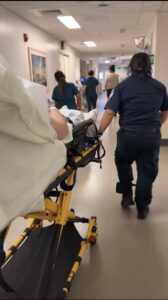
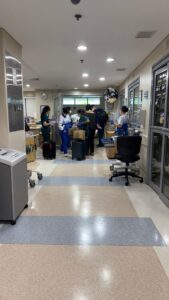
In this case, our medical escort team repatriated a 33-year-old male patient from St. Luke’s Medical Center Global City, Manila, Philippines, to Concord, USA via air ambulance.
The patient had been admitted with severe abdominal pain secondary to Irritable Bowel Syndrome (IBS) and was subsequently diagnosed with celiac artery compression (Median Arcuate Ligament Syndrome, or MALS). His hospitalization became more complex due to significant pain episodes that required ICU care, sedation, anxiety management, and psychiatric support.
During his admission, he underwent a CT-guided celiac plexus block, which significantly improved his pain control. By discharge, the patient was pain-free, hemodynamically stable, fully conscious, and fit for long-haul medical transport.
Preparations Before Transport
Every international air ambulance mission requires meticulous preparation to ensure a safe transfer. Before departure, our medical escort team took several important steps.
We held multiple discussions with the treating team and ICU nurses about the patient’s clinical progress. Our team reviewed his complete medical history, investigations, medications, and discharge summary. We also requested updated blood investigations including Full Blood Count (FBC), Renal Profile, and Liver Function Test (LFT).
The team confirmed the patient’s neurological status, respiratory condition, pain control, mobility, and bowel and urinary function. We made sure adequate medication supplies were prepared for the entire journey and requested an additional peripheral intravenous line be inserted before departure.
We also coordinated with the hospital about medications that might be needed during transport, including sedation and pain relief if necessary. The entire transport from Manila to Concord would involve approximately 20 hours of continuous patient care.
Challenges and How They Were Managed
One of the main challenges was communicating with the treating physician, who was difficult to contact due to clinical commitments. This made it challenging to obtain final clarification about the patient’s readiness for transfer.
Our coordination team worked closely with the ICU nursing staff and arranged discussions with the resident physician instead. This ensured we obtained all necessary clinical information before departure. Continuous communication between the hospital, our medical escort team, and the receiving facility meant no critical information was missed.
We also considered the patient’s history of severe abdominal pain and anxiety carefully. Given his previous ICU admission that required sedation and pain management, we planned thoroughly to ensure appropriate medications, intravenous access, and monitoring equipment were available throughout the journey.
Fortunately, the patient’s condition had improved significantly following the celiac plexus block, which allowed the transfer to proceed safely.
The Medical Escort Journey
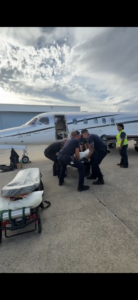
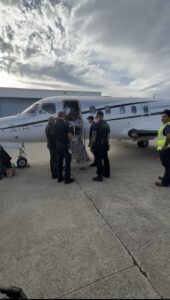
The air ambulance departed from Manila, Philippines, for the 20-hour journey to Concord, USA.
Throughout the flight, the patient remained hemodynamically stable, alert, and oriented. He was comfortable, pain-free, and free from respiratory complications. There were no medical complaints or signs of deterioration.
Our team maintained continuous monitoring throughout the transport. No emergency interventions were required.
Conclusion
This mission demonstrates why detailed medical planning, multidisciplinary communication, and thorough pre-flight assessment are so important for successful international medical repatriations.
Despite the complexity of the patient’s recent hospitalization, which included ICU care, severe pain episodes, anxiety management, and an interventional pain procedure, the transfer was completed smoothly without incident.
The patient arrived safely in Concord, USA, after approximately 20 hours of transport. He remained clinically stable and comfortable throughout the entire journey.
At EMA Global, we approach every medical repatriation with meticulous preparation and patient-centered care. This successful mission reflects our medical escort team’s dedication and the close collaboration between healthcare providers that ensures patients receive safe and seamless continuity of care across international borders.

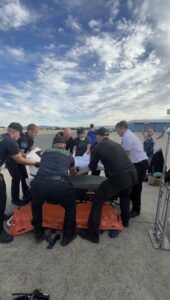
Credits write up and photos:
Nurse Clare F. Dan
Nurse Jenifer M. Francis

