


EMA Global in The Straits Times: Inside Our Flying ICU
 News and Insight
-
August 20, 2026
 News and Insight
 August 20, 2026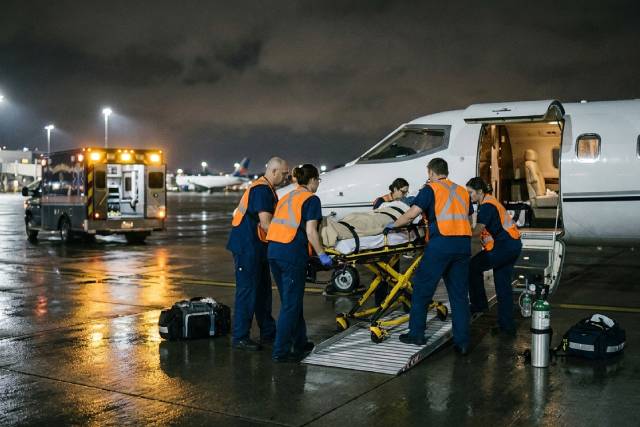
Readers of The Straits Times met one of our own in late July. Its On The Job series, which invites people to describe their working lives in their own words, sat down with Winston Jong, the flight physician who founded EMA Global. The piece ran on 28 July 2026 under the headline about keeping people alive, and it followed him through the highs and lows of delivering intensive care at 40,000ft.
We are proud of the feature, though not simply because it put our name in the national paper. What the article captured is the part of aeromedical work that clients rarely see. Not the jet on the tarmac, but the hours of assessment, packing and planning that happen before anyone boards, and the judgement calls that a flight doctor has to make alone.
The observation that started a company
Winston is 70 now and still practises as a consultant anaesthetist alongside his flight work. Back in the 1990s, working in a private hospital intensive care unit, he kept receiving patients who had been flown in from overseas and who arrived in poor condition. The transfers themselves were doing harm.
He decided he could do something about it. Equipment was bought, a medical team was assembled, and connections were built with hospitals and aircraft operators. EMA Global was founded in 1991, at a point when aeromedicine was barely practised in this part of the world. Thirty-five years on, the same principle drives the work: move patients between hospitals, countries and continents, whether the destination is home or a hospital with better capabilities.
Two very different kinds of medevac
Winston drew a distinction in the interview that anyone weighing up their options should hear, because the two services are often confused.
The first is essentially a taxi flight for non-urgent cases. Break a leg in a remote part of Indonesia and you may be perfectly stable, yet a cast and crutches make a domestic flight to Jakarta genuinely difficult. A plane collects you because it is practical.
The second is the urgent air ambulance, used for life-threatening situations. A stroke, a severe pneumonia or a heart attack in a place without the right facilities becomes a race to reach a hospital that can improve the odds. Our teams have collected patients from some remarkably remote spots, including a honeymooner in Micronesia who suffered a serious head injury when a coconut fell on him.
What drives the air ambulance cost
Families ask about money early, and the honest answer surprises people. The air ambulance cost depends far more on where you are than on how complicated your condition is. Roughly ninety per cent of the total sits in the aircraft itself.
Distance is therefore the main lever. A flight from Tokyo to Singapore typically runs to around US$100,000, while Jakarta to Singapore is closer to US$25,000. Insurance covers the bill for many clients, and those without cover pay directly.
There is a middle path, and we use it often. Patients with less severe conditions can be escorted and repatriated on scheduled commercial flights, with our medical team travelling alongside them. That option typically costs about a fifth of a full air ambulance charter, and for the right patient it is just as safe.
|
Option |
Typical use |
Relative cost |
| Air ambulance charter | Critical or unstable patients, stretcher and ICU equipment | Full charter price |
| Commercial flight with medical escort | Stable patients who need supervision, not intensive care | Around 20% of a charter |
Cases the crew do not forget
Our patients range from newborns to elderly people close to death, and every case involves a life. The Straits Times headline picked out two extremes. One was a premature baby weighing just 800g. The other was a 250kg man flown from Samoa to Sydney, the heaviest patient we have ever carried, who had been turned away by other operators and by commercial airlines because his shoulders were too wide for their aircraft doors. We assessed remotely whether he would fit, worked out how to lift him safely, sourced a stretcher rated for his weight, and got him home.
Fifteen years ago we moved a young Englishman from Bangkok to London for a heart transplant while he was supported by an ECMO machine, with the flight doctor managing both the ECMO circuit and his ventilator throughout. We have carried a four-week-old with a bleed on the brain after an accident in South Korea, moved patients with psychiatric conditions after careful pre-flight assessment, repatriated mortal remains, and operated hospice flights for clients whose last wish is to die at home. A 20-hour air ambulance repatriation from Manila gives a sense of how much coordination a single long-haul mission demands.
Preparation is most of the job
Winston’s description of the cabin is the line people remember. Up there, he said, “it’s just you, your equipment and God”. Nobody else can help.
That is why the groundwork carries so much weight. Very often the patient is not in Singapore at all, so the team assesses someone in Ho Chi Minh City or Port Moresby from a desk here and works out what could go wrong in the hours before the next hospital. Going in blind is the mistake that ends badly.
A typical mission carries oxygen cylinders ranging from 5kg to 60kg, plus equipment bags holding ventilators and infusion pumps. Crews bring headlights for refuelling stops in the middle of the night, when the engines are off and the cabin has no lighting, along with backup batteries to keep the machines running. Physical fitness turns out to be one of the most underrated requirements of the job.
The people we put on board
Doctors and nurses joining our teams need several years of ICU experience before they fly, and even then flight physiology is taught on the job. Our associate medical director, Giju Gnanadhas, trained as an anaesthetist before joining in 2021. A patient lying flat during take-off experiences a surge in blood pressure that a seated passenger never notices, and on landing the blood shifts to the legs. Anticipating that sort of thing is the skill.
No law governs how aeromedicine is practised at 40,000ft. We hold voluntary accreditation from the European Aero-Medical Institute and the Commission on Accreditation of Medical Transport Systems, both of which examine our equipment, our pharmaceutical bag and our safety culture. Long missions run under a fatigue management system, with an extra escort added when care duties need rotating.
Talk to us
Our thanks to The Straits Times, and to Sharon Salim, for telling this story properly. If the feature left you curious about how a transfer works, the short answer is that a good one looks uneventful from the outside because so much thinking went in beforehand.
EMA Global provides medical evacuation, repatriation and air ambulance services across Asia and worldwide, with clinical teams and coordinators available at any hour. If you are arranging care for someone overseas, or you simply want to understand your options before you need them, get in touch with our team.

